

What a late supplier costs, and what to ask them for.
Once a month marql's AI Inventory Manager scores every supplier with three or more deliveries in 90 days: on time and in full, lead time and its spread, price rises, the empty shelf that followed and who else could deliver. This playbook follows one real review at Tuzeffy, the operator of Yammy Way and Pralio, from that agenda to the four things a buyer can ask for, and prices each one before the meeting.
At stake
€3,626
lost sales in 90 days, at shelf price — 19,381 lei on the screen
- read from the ERP, not a survey
- spread, not just the average
- lost sales ≠ the supplier's fault
Sections
Everything arrives. Almost nothing arrives on time.
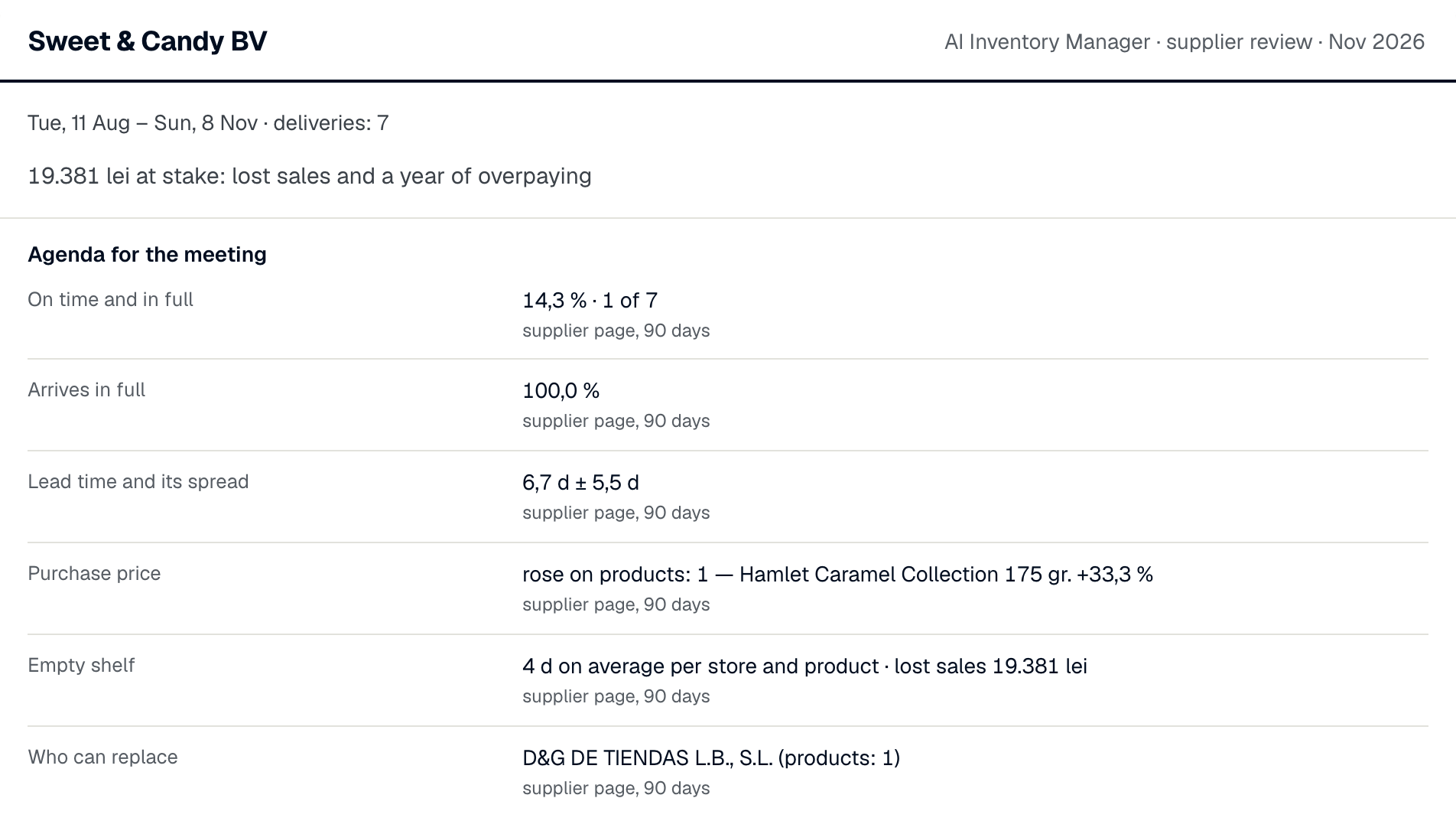
Tuzeffy runs four candy stores in Romania — three Yammy Way and one Pralio — plus a warehouse, and marql reads them from the chain's ERP. In November the AI Inventory Manager put Sweet & Candy BV first in its queue of supplier reviews. Over 90 days the supplier made 7 deliveries and every line arrived in full, but only 1 of the 7 arrived on time; the lead time averaged 6.7 days and swung by 5.5 days either way. Shelves of its products stood empty 4 days on average per store and product, and the review prices that at 19,381 lei of lost sales — €3,626 at the ECB reference rate of 5.3451 lei to the euro on 11 November, the rate every euro figure on this page uses. That figure is easy to misread twice: it is ninety days, not a year, and it is every empty day, not only the ones the supplier caused.
- 1 of 7
- deliveries on time and in full
- ±5.5 d
- lead-time spread on 6.7 days
- €3,626
- lost sales in 90 days
- ≈€5,770
- margin a year the lateness costs, at most
From a delivery log to an agenda for the meeting.
Four stages. The second is the one a spreadsheet usually skips: the spread of the lead time, not its average, is what empties a shelf.
Once a month, every supplier with enough deliveries gets a review.
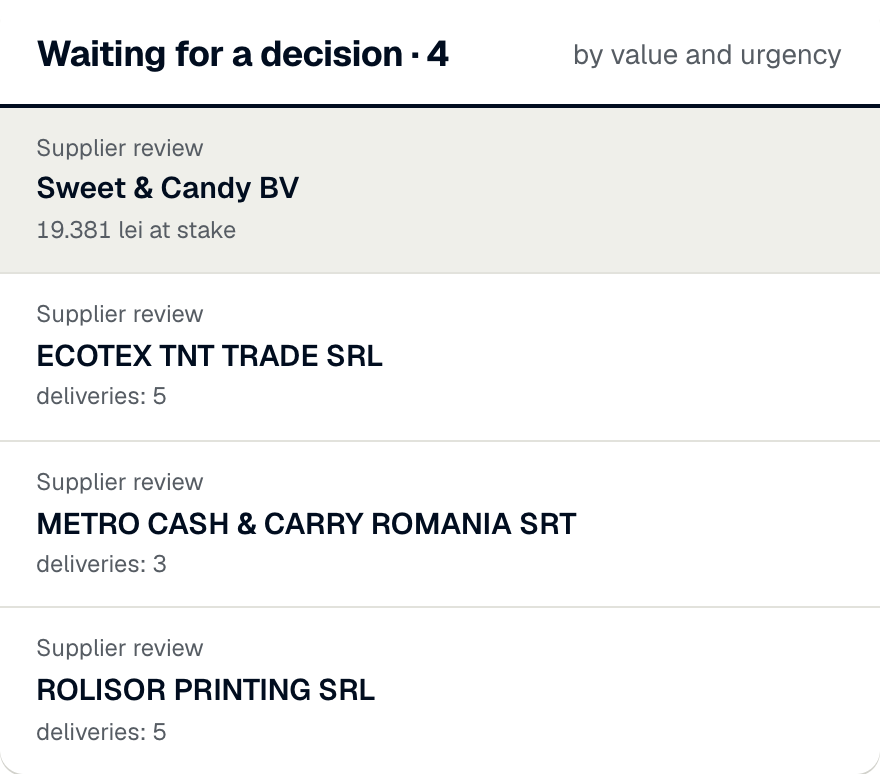
The AI Inventory Manager reviews each supplier that made at least three deliveries in the last 90 days and queues the reviews by money and urgency. At Tuzeffy that was four suppliers in November. Sweet & Candy BV led with 19,381 lei (€3,626) at stake; the other three carry only a delivery count, because the review prints money only where the data supports it.
Monthly · ≥ 3 deliveries in 90 days · ranked by money × urgency
The supplier page separates late from short, and the average from the spread.
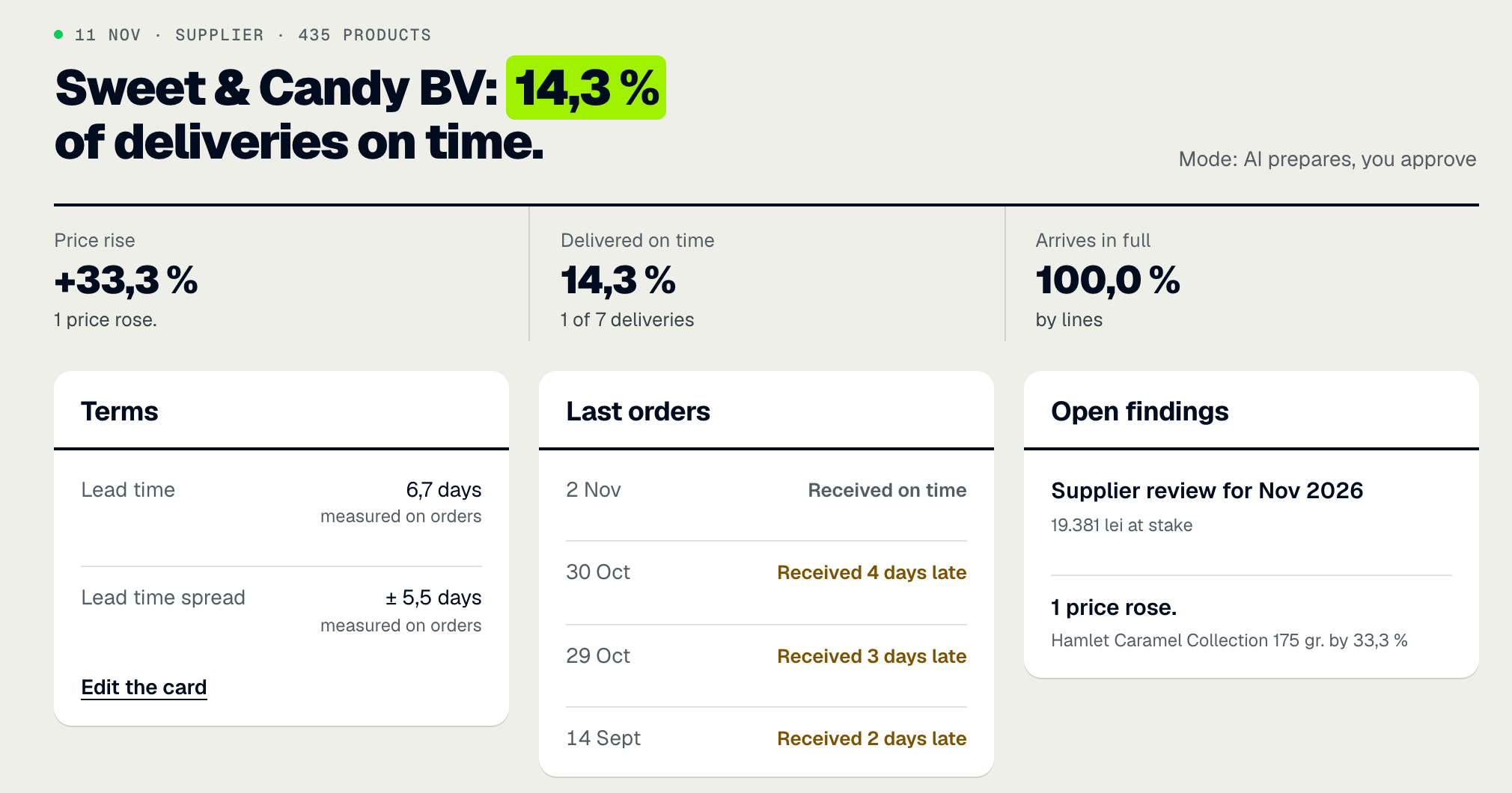
Every line arrived in full, so quantity is not the problem; timing is. Six of seven deliveries were late — the last orders show 2, 3 and 4 days late — and a 6.7-day lead time with a 5.5-day spread means one order can land in a day and the next in twelve. A buyer who negotiates the average down and leaves the spread alone keeps the empty shelves. The page also flags one price rise: Hamlet Caramel Collection 175 gr., up 33.3% from the previous receipt.
90 days · measured on orders · 435 products from this supplier
The review becomes an agenda, with a date to decide by.
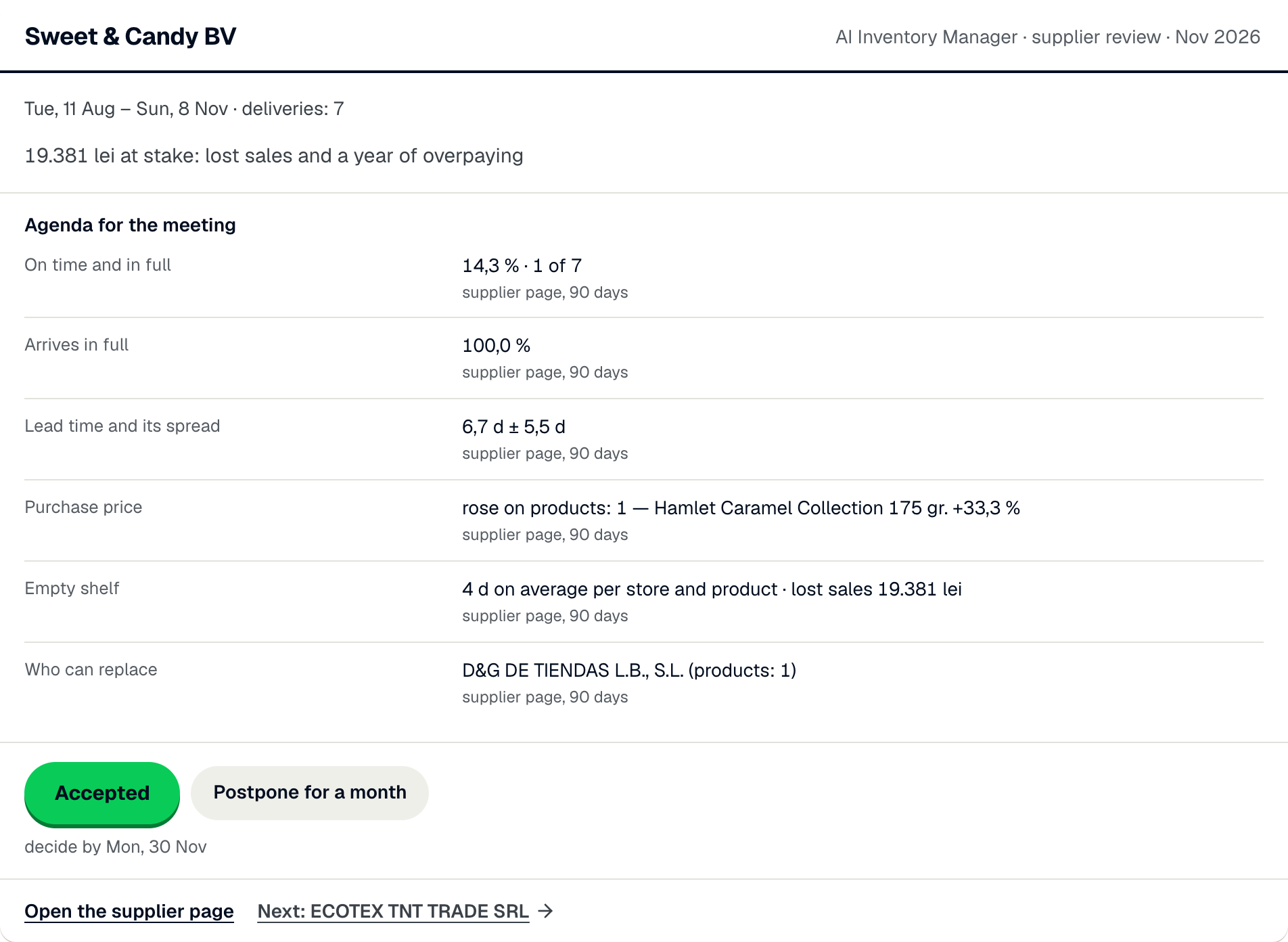
Six lines, each with its source: on time and in full, arrives in full, lead time and spread, purchase price, empty shelf, who can replace. The AI Inventory Manager prepares; a person accepts or postpones for a month, and the item says when it is worth deciding by — here, Monday 30 November. One line is worth reading twice: the only replacement it names delivered one of this supplier's 435 products.
Every line sourced · AI prepares, a person approves · decide by the month's end
A meeting is not a result until the next quarter of deliveries says so.
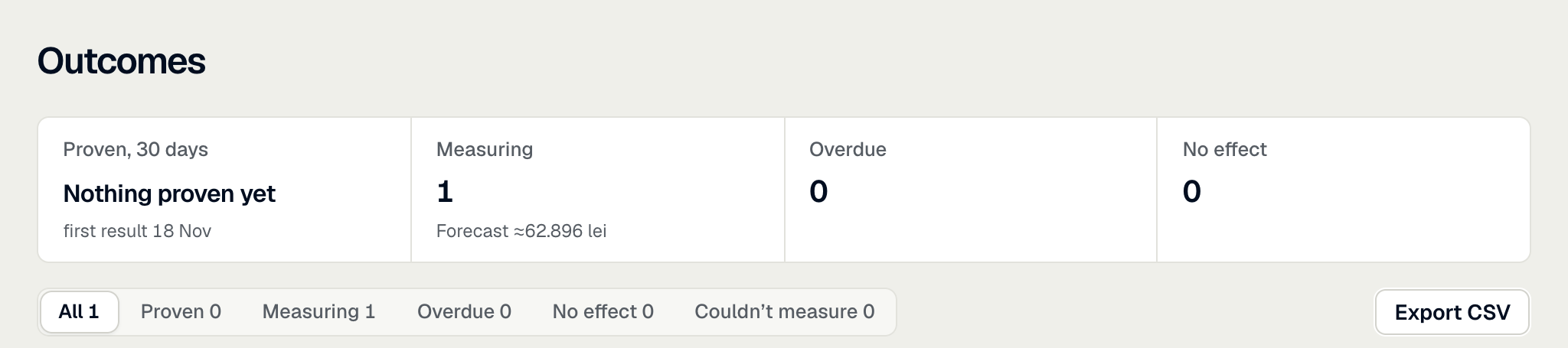
Seven deliveries in 90 days is a small sample: one on-time delivery after the meeting moves the rate from 14% to 25% and proves nothing. The measurement has to be fixed before the meeting — the rate, the empty days, the window — and closed only after enough deliveries to tell a change from luck. Tuzeffy's Outcomes screen on the day of reading shows the honest state of an account early in that cycle: nothing proven yet, one decision measuring.
Baseline frozen before the action · no-effect counts toward measured, never proven
Late on paper can be right on the shelf.
The delivery log is not in question: six of seven receipts came after the expected date, and the shelves were empty. What is in question is whose lateness it was. In five ordinary situations the supplier is blamed for days it did not cause, and a buyer who walks into the meeting with them hands the supplier an easy answer.
The promised date was never promised
On time and in full needs a promised date. If the expected date on the order is the system's default lead time rather than a date the supplier confirmed, “late” means later than our own guess. The rate is still useful — it measures how far the guess is from reality — but it is not a broken promise.
Open the last three orders and look for the supplier's confirmation. If the expected dates are all the order date plus the same number of days, nobody agreed them, and the first ask in the meeting is a date, not a penalty.
The shelf was empty, the warehouse was not
Tuzeffy runs a warehouse beside its four stores. The review counts empty days per store and product, so a box sitting in the warehouse while a store's tray ran out reads exactly like a supplier who did not deliver. That is a transfer rhythm problem with the supplier's name on it.
Warehouse stock of the same product on the store's empty days. Stock in the warehouse on those days moves the empty days from the supplier's column to the chain's own.
The product is not sold under its own line
Candy sold by weight is poured from boxes into trays and rung up under price-per-100g lines, and this happens in this very account: at Pralio, boxes of chocolate and nuts are sold that way, so no receipt names the box. A product that never sells under its own code has no sales to price an empty day with — or reads empty while the tray is full.
Does the product sell under its own till line in this store? If the shop floor sells it under a weight line, count the trays by hand and leave this product out of the money.
The order was held at our request
Orders merged to fill a pallet, held to meet a minimum, or moved to the supplier's next route to save freight arrive later than the first order date by design. The log shows lateness; the purchase file shows a choice.
Were any of the late orders combined or rescheduled by the chain? Those come out of the rate before the meeting, and the supplier will bring them up if you do not.
A peak week, not a pattern
Two of the late deliveries fell on 29 and 30 October, the week before Halloween, which is a peak for any confectionery supplier. A supplier late only in its busiest week needs an earlier order from you, not a new contract.
Lateness outside the peak. Here the answer is already on the page: 14 September came 2 days late, well clear of any peak, so this supplier's lateness is not only seasonal.
In short
None of these makes the empty days disappear: the shelves were empty and the sales did not happen. What changes is who answers for them. Three of the five move days from the supplier to the chain, one removes a product from the money, and one says to order earlier rather than to renegotiate. marql can recognise a reason only where it is in the data — a warehouse stock, a till line, a confirmed date. A merged order agreed on the phone is invisible to it, and writing it down is part of preparing the meeting.
The supplier was late. The meeting still failed.
Five ways the review goes wrong after the lateness was real, in the order they happen: the wrong culprit, the wrong ask, the wrong exit, the wrong trade and the wrong proof. These are constructed, not observed — none of them happened in Tuzeffy's account.
Charging the supplier for every empty day
The buyer opens with €3,626 and asks for a credit. The supplier's account manager asks which days were theirs, points to the warehouse stock on two of the store's empty weeks and a merged order in October, and the conversation becomes a dispute about the number instead of a plan for the dates. The figure counts every empty day, whatever caused it, and the product says so in its method; quoting it as damages invites exactly this.
Split the empty days before the meeting: those that followed a late delivery, and those that did not. Bring the first group and the delivery dates behind it. A smaller number the supplier cannot argue with is worth more than a larger one they can.
Negotiating the average and leaving the spread
The supplier agrees to five days instead of 6.7. Three months later the average is five days and the shelves are just as empty, because the spread is still five days either way and the chain still orders as if the lead time were fixed. A shorter average with the same spread moves the problem two days earlier.
Ask for a window, not an average: a confirmed delivery date per order, plus or minus one day, and the on-time-and-in-full rate measured against it. The spread is the number that sets how much stock the store needs to stay full, so it is the number to buy down.
Threatening to switch with one product to switch
The agenda names a replacement, and the buyer treats it as leverage. But D&G DE TIENDAS delivered one of this supplier's 435 products in the window. Moving that product leaves 434 lines with the same supplier, now buying less and with less reason to prioritise the chain, and the threat was visibly empty from the first minute.
Count what a replacement has actually delivered before naming it. One product is a test order, not an exit; an exit needs coverage of the lines that drove the empty days. If no such supplier exists, the meeting is about dates and price, and saying so is stronger than bluffing.
Trading the price for the date without pricing either
The supplier offers punctuality in exchange for keeping the 33.3% rise on Hamlet Caramel Collection, and it sounds fair. Nobody has priced either side: what the rise costs over a year at current volumes, and what on-time deliveries are worth in margin. The trade is made on how the percentages feel.
Price both before the meeting. The calculator below puts a ceiling on what fixing the lateness is worth in margin a year; the rise is its own percentage times the units bought over a year. A concession is worth making only when the first is larger than the second.
Declaring victory on the next delivery
The delivery after the meeting is on time and the review is closed as fixed. But the delivery on 2 November was on time too, before any meeting, and the rate stayed at one in seven. With seven deliveries a quarter, one good week is noise in both directions.
Fix the baseline and the window before the meeting — on time and in full at 14.3%, empty shelf at 4 days — and close it only after a full quarter or at least seven deliveries, whichever comes later. The review that follows will either show the rate moved or not, and both are answers.
In short
None of the five is a failure of the delivery log, which was right in all of them. Two put the wrong number on the table, two make the wrong ask, and one stops measuring too soon. The first and the second matter most: one turns a plan for the dates into an argument about the money, the other buys a shorter average and keeps the empty shelves.
Start with the one that matters
Which of our suppliers are late often enough to cost us shelf days?
- AWhich suppliers delivered on time and in full on fewer than half their deliveries in the last 90 days?
- BFor this supplier, which empty-shelf days followed a late delivery, and which happened while the warehouse had stock?
- CWhich of its products rose in price, and what is that rise worth over a year at our current volumes?
- DWho else delivered these products in the last 90 days, how many of them, and at what price?
What it takes to score a supplier.
Purchase orders with an expected date
On time and in full is measured against the date on the order. Without orders the page falls back to receipts alone and can say how often the supplier delivers, not whether it delivered when promised.
Receipts by line: date, quantity, price
The lead time, the fill rate and the price rise all come from here. Three receipts in 90 days is the minimum for a review at all.
Daily sales and stock by product × store
Without them the review still scores the deliveries, but it cannot count empty days or price them — so the money line stays empty rather than estimated.
Warehouse stock, transfers and costs
Warehouse stock tells a supplier's empty day from a transfer's. Costs turn lost sales into lost margin, which is the number a concession should be weighed against.
How this was computed
The review, the window and the arithmetic.
The product's own account: once a month, for every supplier with at least three receipts in 90 days, the AI Inventory Manager puts one item before a person — the facts for a meeting with the supplier. Every figure is read off the supplier page; the review adds no formula of its own.
The supplier page's 90 days. Lead time and spread are the mean and standard deviation from order to receipt; the fill rate is received over ordered; a price rise is the last receipt price against the one before, from 3% up.
- on time and in full = deliveries on time and complete ÷ deliveries with a promised date
- lost sales per store × product = sales in the window ÷ days in stock × days empty
- at stake = lost sales + a year of overpaying (an unknown part counts as 0)
- margin lost a year = lost sales × gross margin × 365 ÷ 90
- worth conceding a year, at most = margin lost a year × share of empty days after a late delivery
- ERP sync
- orders · receipts · daily sales · daily stock
- supplier page, 90 days
- monthly supplier review
- supplier page · tiles
- onTime, emptyShelf (avgDays, lostSales, pairs)
- supplier page · reliability
- leadDays, leadStdDays, fillRatePct
- supplier page · findings
- price_rise, products[].replacements
The first three lines are the product's; the last two are this page's. Lost sales are priced at shelf price, over ninety days, and count every empty day whatever caused it — the review is a ranking and an agenda, not an invoice to send the supplier. On this card the total equals the lost sales, so the year of overpaying came to zero: the 33.3% rise is listed, and its money is left uncounted rather than guessed.
Check it on your own numbers
The last two equations above, plus the buffer that would absorb the spread instead. It opens on this review's figures, so the first thing it prints is the €3,626 in the hero turned into a year of margin — change any field and the arithmetic follows.
- Margin lost a year
- €11,544
- Worth conceding a year, at most
- €5,772
- Extra cover that absorbs the spread
- 9.1 days
Two of the four fields are assumptions. The margin opens at 78.5%, Tuzeffy's chain-wide gross margin on the Economy screen for 12 Oct – 10 Nov, not the margin on this supplier's lines — use your own. The share opens at half because nothing on the review splits empty days by cause; failure mode A is how to find yours. The buffer line is 1.65 times the spread, enough for roughly 19 deliveries in 20 if demand were steady: it says how many extra days of cover the store would need, not what holding them costs — that needs a carrying rate this page does not invent.
The supplier is one conversation. Three seats prepare it.
A supplier review ends in a meeting, and the meeting has one owner. Preparing it takes three seats that see different things: the store sees the shelf, the AI Inventory Manager sees every delivery and every empty day across the chain, and the owner or COO is the one who can sign what the supplier is offered. The product draws the line itself: the supplier page reads “AI prepares, you approve”, and only the owner or COO can raise how far an AI employee may go.
Store manager
Own store, and the one seat that knows what the shelf looked like on the empty days and what was sitting in the back.
- The till-line counter-case: whether a product is sold under its own code or poured into a weight line.
- Confirming the empty days that followed a delivery, and the ones that followed a transfer that did not come.
- Receiving: what arrived, when, and whether it was complete — the record the fill rate is built on.
The supplier's terms. A store sees its own deliveries, not the other three stores', and a supplier late at one address may be on time at the rest.
Empty days in their store on this supplier's products, and whether receipts are booked the day they arrive.
AI Inventory Manager
Every store, every delivery and every empty day across the chain — and, while no AI buyer is hired, the supplier reviews themselves.
- The monthly review: which suppliers qualify, the agenda, the money, and the date to decide by.
- The arithmetic a person would skip: the spread, the lost sales per store and product, who else delivered the goods.
- Return drafts to this supplier, once its return terms are entered — on this supplier page they are not yet.
The meeting and the signature. It prepares and a person approves, and it cannot see a merged order agreed on the phone or a promise made outside the ERP.
Whether the reviews it raises are decided by their date, and whether the rate it measures moves after them.
Owner or COO
The whole network and the money, and the only seat that can change a supplier's terms or give an AI employee more authority.
- The ask: a confirmed date window, a price, a second source, or more stock to carry.
- The trade in failure mode D — what the chain gives up in price for what it gets in punctuality.
- Accepting the review or postponing it a month, and saying why.
The facts in the back room. Whether the warehouse had the box on the empty day is the store's to confirm, and a claim made without it is the one the supplier wins.
On time and in full and empty shelf days over the quarter after the meeting, against the baseline frozen before it.
In short
These are the seats the product ships, not a claim about how a chain should be organised. A chain with a buying office or an AI buyer hired moves the review to that seat — the product hands supplier reviews to the buyer when there is one. Map your own titles onto the seats: what matters is that the person who signs the terms is not the only one who has seen the shelf.
Everything above, on one spreadsheet.
None of this needs marql. A delivery log, a sales export and an afternoon are enough for one supplier. What the product automates is doing it for every supplier every month, with the empty days counted per store and product. Take the method; if the arithmetic keeps changing what you ask suppliers for, that is the case for automating it.
Is it the supplier, or is it us?
The counter-cases from section 3 as a tree. It runs before any money is discussed, because four of its endings take days away from the supplier's column.
Do the late orders carry a delivery date the supplier confirmed?
- No
- Lateness is measured against your own guess. Agree dates first; a rate against a default is a finding about your planning, not a broken promise.
- Yes
- The promise existed. Continue.
On the empty days, did the warehouse or another store hold the product?
- Yes
- Those days belong to your transfers, not the supplier. Take them out of the count and fix the transfer rhythm.
- No
- The chain had none. Continue.
Is the product sold under its own till line?
- No
- Sold by weight under another line, it has no sales of its own to price. Count trays by hand and leave it out of the money.
- Yes
- The lost sales can be priced. Continue.
Was the supplier late outside peak weeks and outside orders you merged or held?
- No
- A peak slip or a choice of yours. Order earlier before the peak; there is nothing to renegotiate.
- Yes
- It is the supplier's pattern. Go to part B.
One of five endings: agree dates, fix transfers, count trays by hand, order earlier for the peak, or price the supplier's lateness in part B.
What the lateness costs a year
Failure mode A in worksheet form: from the figure on the review to the margin a year the supplier's lateness actually costs.
- Lost sales in the window
- Straight off the review, or per store and product: sales in the window divided by the days the product was in stock, times the days it was empty. At shelf price.
- Length of the window, in days
- marql's review reads 90. Write yours down beside the figure — a quarter mistaken for a year is the easiest error on this sheet.
- Gross margin
- This supplier's lines if you have their costs; the chain's blended margin if not, labelled as such. Tuzeffy's chain-wide figure for 12 Oct – 10 Nov was 78.5%.
- Margin lost a year
- Lost sales times margin times 365, divided by the window. On this review that is about €11,540.
- Share of empty days that followed a late delivery
- From part A: the empty days left after removing warehouse days, weight-line products, merged orders and peak slips. If you cannot split them, write down the share you are assuming and label it.
- Margin a year the lateness costs
- The line above times this share. At half, about €5,770 on this review. This, not the review's headline, is what the meeting is about.
One figure: what the supplier's lateness costs in margin a year — the ceiling on anything you give up to fix it.
What to ask for in the meeting
The four asks — a date, a price, a second source, a buffer — priced side by side, so the one you lead with is the cheapest to get and the most expensive to refuse.
- A confirmed delivery window
- A date per order, plus or minus a day, confirmed in writing. This buys down the spread, which is failure mode B's lesson: the average is the wrong thing to negotiate.
- The on-time-and-in-full target
- The rate you will measure against that window, and the review date when you will look. Write today's beside it: 14.3% here.
- The price on the products that rose
- Each rise times the units you buy a year. On this review, Hamlet Caramel Collection 175 gr. at +33.3% — priced in euros before the meeting, not argued in percent.
- Worth conceding, at most
- Part B's margin a year the lateness costs. Any price you accept in exchange for punctuality must cost less than this, or failure mode D has happened.
- A second source, and what it covers
- Products a replacement actually delivered in the window, out of this supplier's total. One of 435 here: a test order, not leverage.
- A buffer instead
- About 1.65 times the spread in extra days of cover, times daily sales at cost of the affected products. That is capital tied up, to set against the margin in part B — and on a chain already holding months of cover, a sign the problem is where the stock sits, not how much there is.
- The ask, and its price
- Which one you lead with, which you hold back, and what you will do if the supplier says no to all of them.
An agenda you lead rather than the supplier's account manager: one ask first, its price, and the fallback.
Fix the measurement before the meeting.
Failure mode E in worksheet form, and the only part with a deadline: every field is filled in before the meeting, because once the next deliveries are known none of them can be chosen honestly.
- The action, in one sentence
- What was agreed with the supplier, for which products, from which date.
- Owner
- A name holding a seat that can sign supplier terms — section 7. The review can be prepared by anyone; the agreement cannot.
- Baseline, frozen now
- On time and in full and empty shelf days per store and product over the last 90 days, pasted as values. Here: 14.3% and 4 days.
- Measurement window
- The next full quarter, or at least seven deliveries, whichever ends later. One delivery is noise in both directions.
- The metric
- On time and in full against the agreed window. One metric — empty days move for reasons the supplier does not control, so they are a check, not the verdict.
- Comparison
- Your other suppliers over the same weeks. If every supplier got better at once, the season changed, not this supplier.
- What would void the window
- A peak week inside it, merged or rescheduled orders, a change of route or warehouse. Any of these and the honest verdict is couldn't measure.
- What counts as no effect, and as worse
- Both, written before you know them. Worse is reachable: a price concession paid for a rate that did not move.
A row that can close as proven, no effect, worse or couldn't measure. If the last three are unreachable in your version, the first one is not worth having.
In short
That is the whole method. What marql adds is not a better equation: it reviews every supplier every month rather than the one somebody complained about, counts empty days per store and product rather than by impression, and keeps the baseline frozen so the next review answers the last one. The share of empty days that is the supplier's is a number neither of us can read off a screen — part A is how you find it.
9 · The line proof stops at
Lost sales on a shelf
≠ a debt the supplier owes.
€3,626 — 19,381 lei on the screen — is the revenue Tuzeffy's stores did not take on this supplier's products in ninety days, counted on every empty store-and-product day at shelf price. It is the figure on the review, and it is not a claim against the supplier: some of those days belong to the warehouse, to weight lines and to orders the chain merged itself, and part A of the worksheet exists to take them out.
It is also not margin and not a year. A year of it is about €14,700 of sales, and at the chain's blended margin about €11,540 of margin; how much of that the lateness caused is the share the calculator asks for rather than prints. Where it lands at half — about €5,770 — is a ceiling on what to concede, not a saving.
And it is not a result. On the day this was read the review was waiting for a decision, due by 30 November, and Tuzeffy's Outcomes showed nothing proven yet. A proven effect is recorded only after the agreement is in place, the baseline is frozen and enough deliveries have come in to tell a change from luck.
Where to go from here
The employee, the chain and the ledger behind this review
Ready to see
the euros it found?
The walkthrough is built around the POS and accounting you already run. Leave your details and pick a time.